Let’s turn a page of History: we are now in the Middle Ages, in Asia. Chess lovers, this is going to be your moment! In the 6th century, in India, Chaturanga was invented, a strategy game considered as the most distant ancestor of chess. But forget about the King, Queen and Bishop: this is about infantry, cavalry, chariots and… elephants! This is not an insignificant fact since it was the composition of the Indian armies of the time. Chaturanga was already played on an 8×8 square board with 16 pieces. We skip the (very) numerous stages of evolution of the game which will lead only in 1475 to the chess we know today.
Chinese civilization also actively participated in the evolution of board games. We owe them several great names in the field, starting with dominoes around 1120. Although this origin is debated, there is no doubt that these small dice transformed into flat tiles were a great success and spread very quickly throughout the world.
We don’t doubt that you have already heard about Go? It was also in China that it was more or less born. Well, for this one, let us cheat a little: we would need at least 3 articles to talk about Chinese dynasties! So, we will get to the essential point. It is true that Go has origins well before the Middle Ages. But if we consider only its current form, we can say that it appeared around the 15th century. You read correctly: “its current form”. Go is more than 5000 years old and doesn’t show any wrinkle, since it is still very popular today.
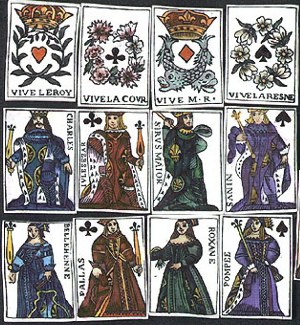
Finally, we can also thank the Chinese for a third major invention in the history of the board game. For it was also in China that the first beginnings of printing took place, or at least of the first large-scale production techniques, which will thus allow the invention of playing cards, around 1370. This type of manufacturing then allows the diffusion and the transport of the cards by the Silk Road, notably towards Europe. This phenomenon will of course be reinforced by the invention of the printing press less than a century later, a historic step for humanity and, on a smaller scale, for the evolution of board games.